Launch offer — valid today only

📄 Digital book in PDF · read it on your phone or print it

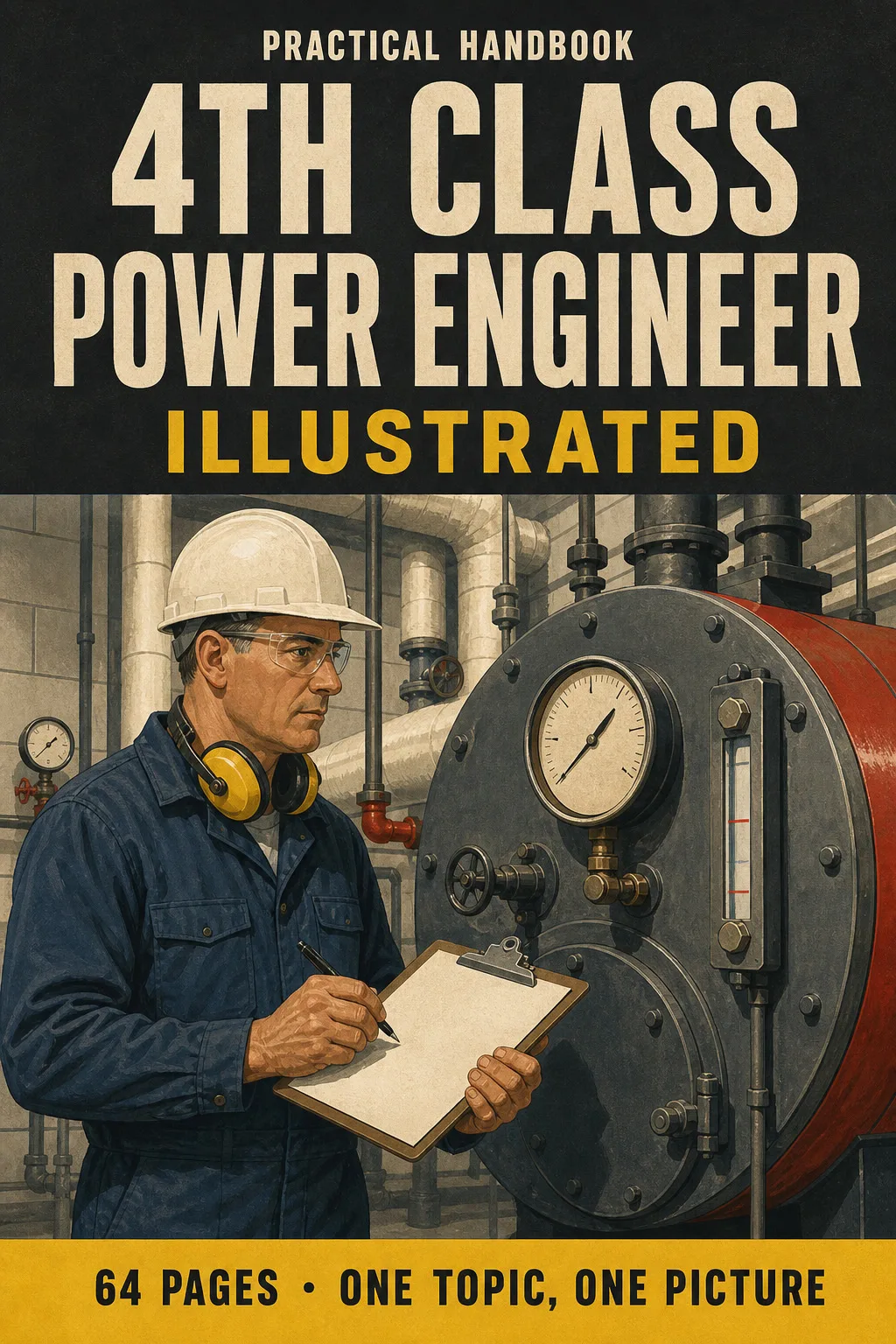
The 4th Class Power Engineer Exam in Drawings Every Boiler, Fitting and Cycle on Its Own Page, Always in the Same Order

The steam plant as a map, firetube and watertube boilers, the safety valve, the gauge glass, burner management, the centrifugal pump and the refrigeration cycle. Every topic gets its own page: the drawing first, then what you need to remember. 64 illustrated pages.

START STUDYING THIS WAY

🔒 Secure checkout · PDF by email · 30-day guarantee

Every topic, its own pageEach boiler, fitting and control drawn, with the explanation beside it
64 illustrated pages9 parts, from the steam plant as a map to how multiple-choice questions are written
Up-to-date sourcesNational 4th Class syllabus, CSA B51 and CSA B52
PDF by emailFormat

Look Inside the Book

Every page has one big drawing and a box with the numbers, limits and steps you need to know:

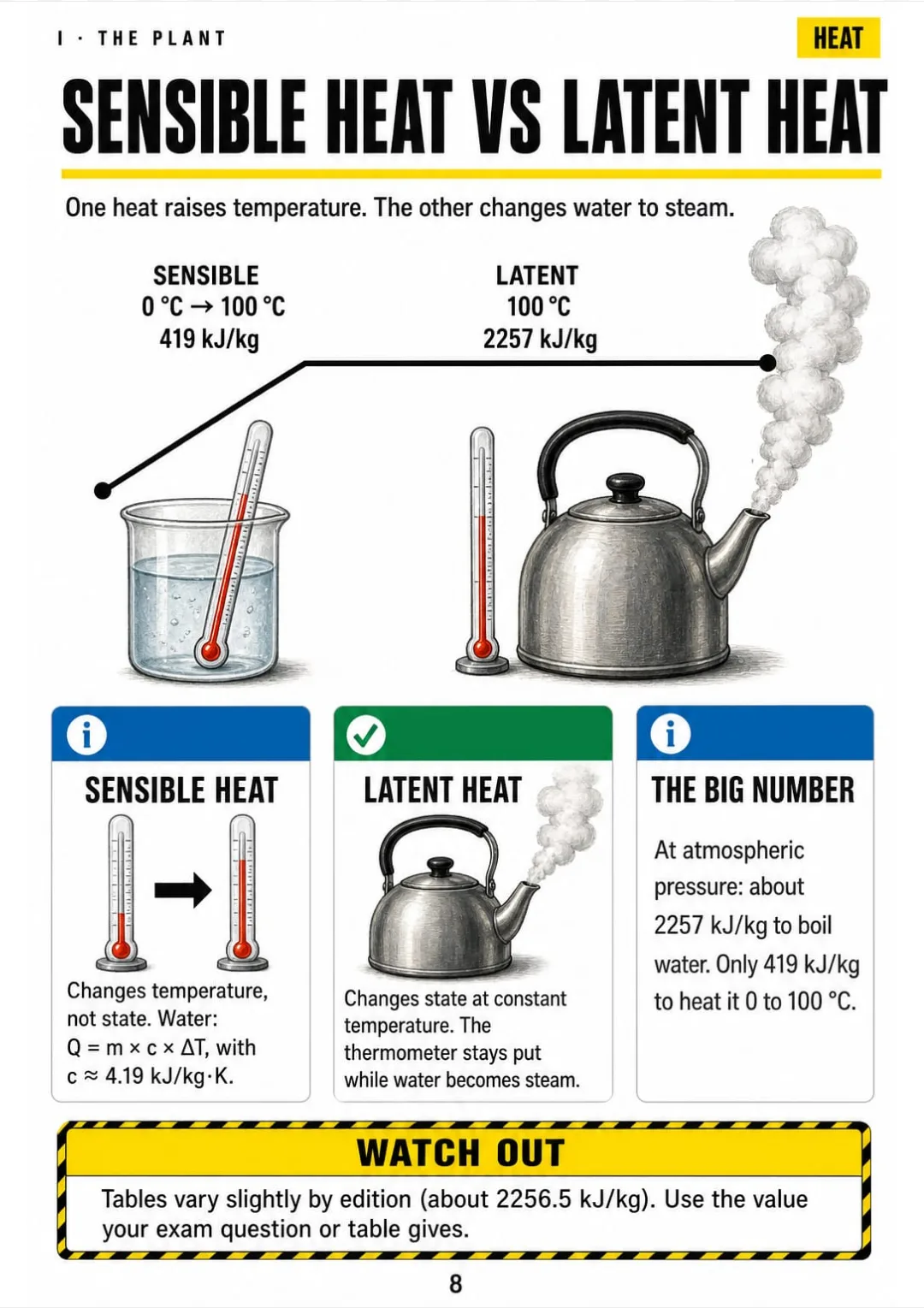
Sensible: 419 kJ/kg (0 → 100 °C) · Latent: about 2257 kJ/kg at 100 °C.
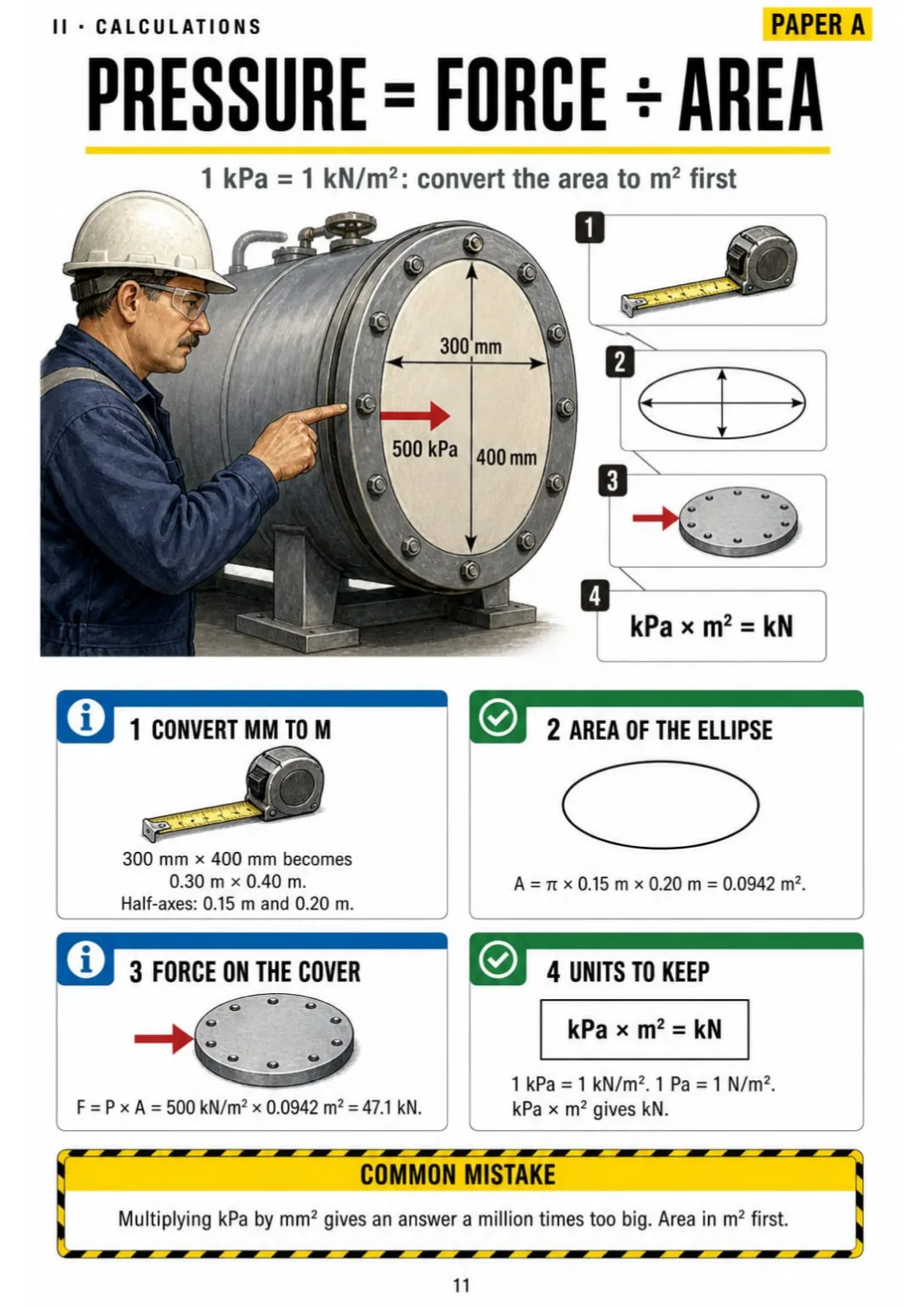
500 kPa on a 300 × 400 mm manhole cover = 47.1 kN, area in m² first
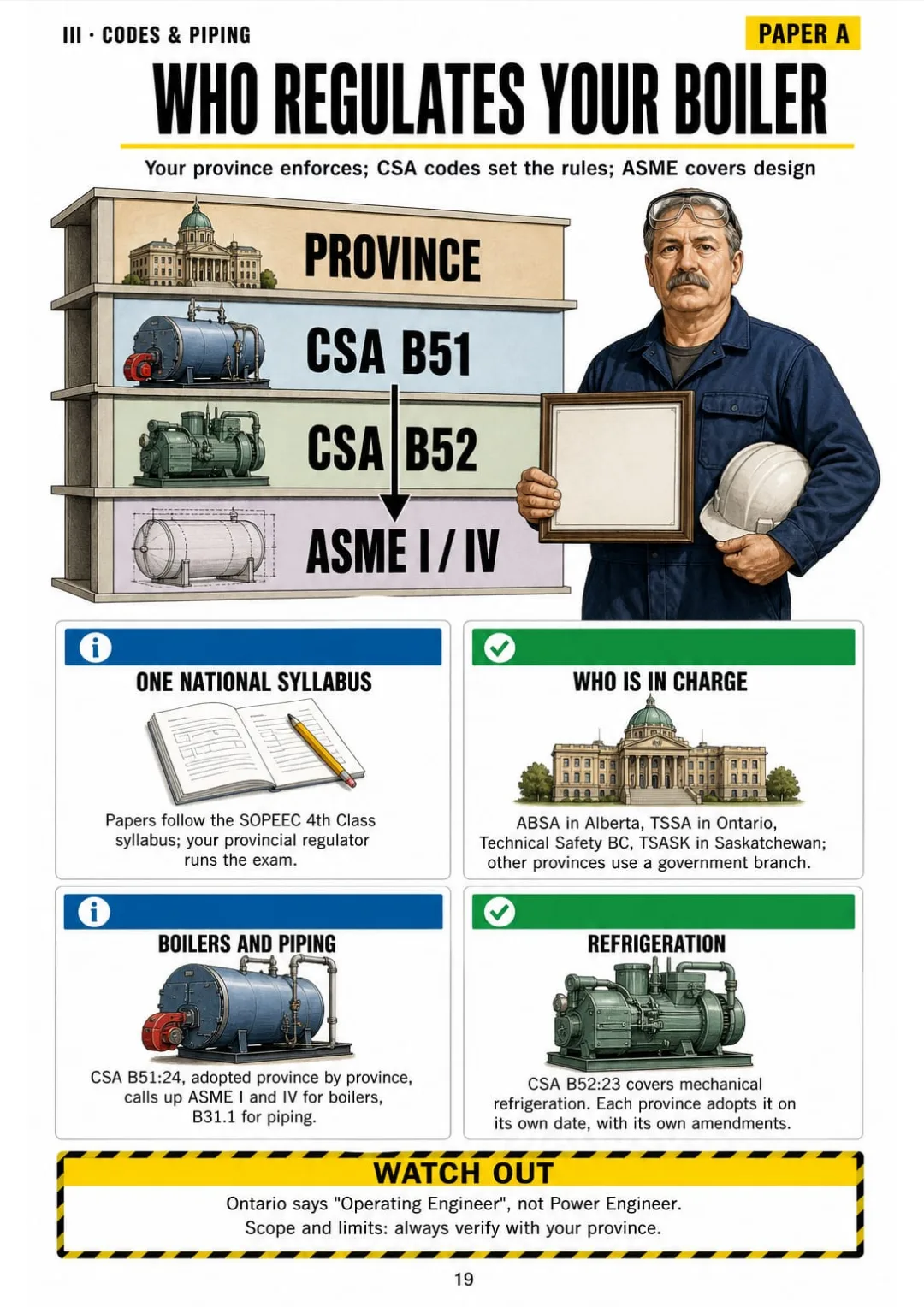
Province enforces, CSA B51:24 covers boilers, CSA B52:23 covers refrigeration, ASME covers design.
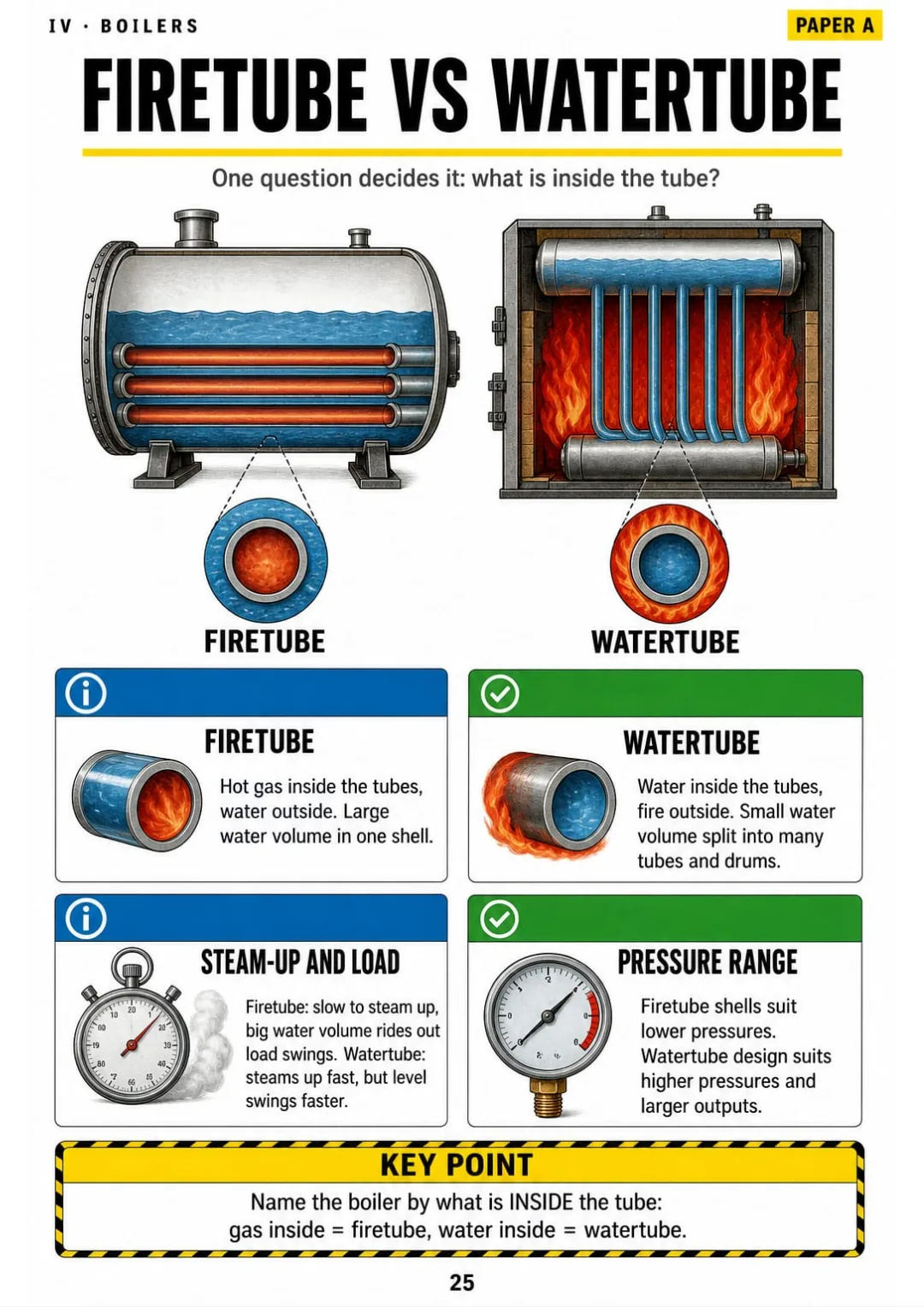
Firetube: hot gas inside the tubes. Watertube: water inside, fire outside.
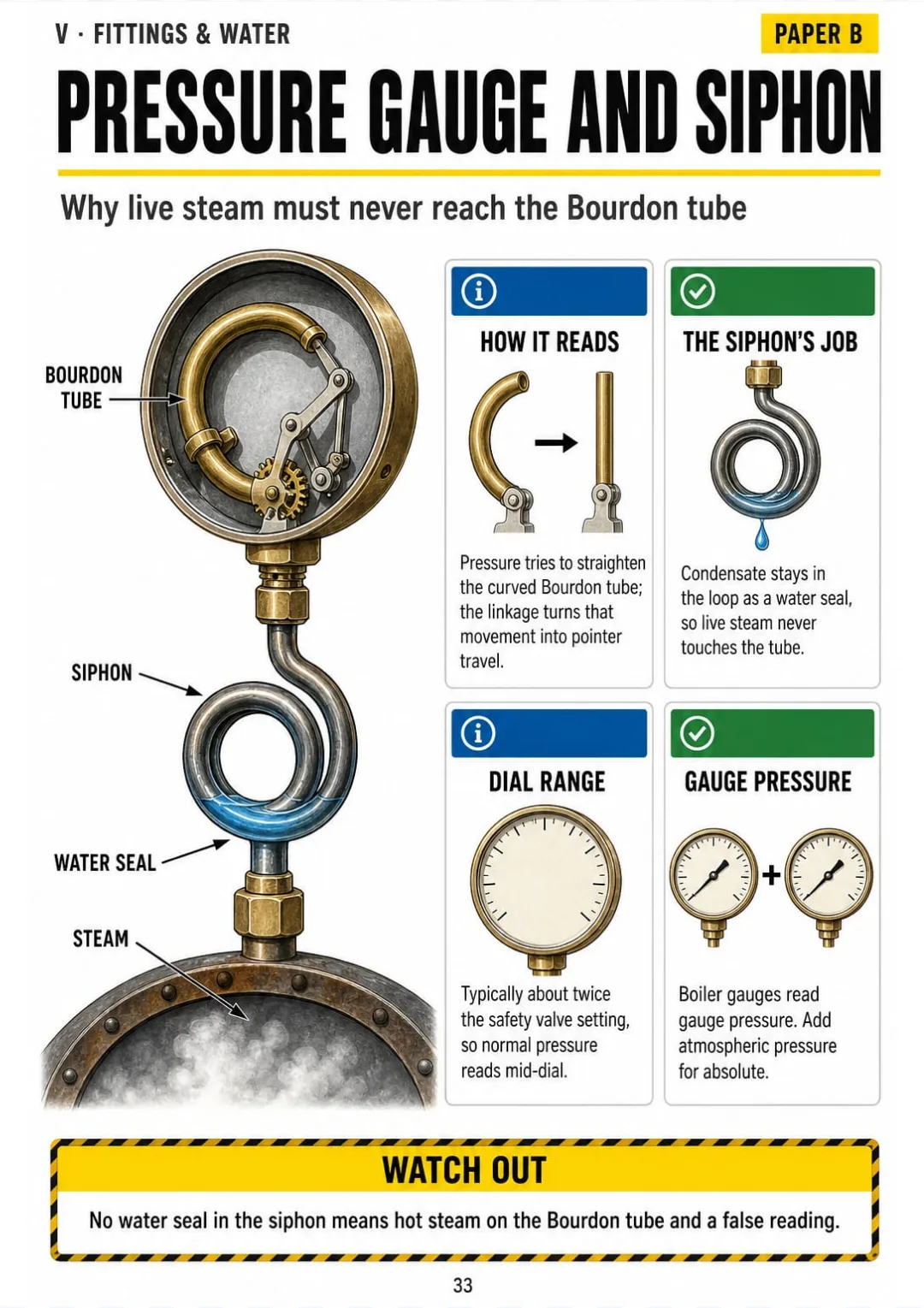
Bourdon tube drawn open and the pigtail siphon's water seal
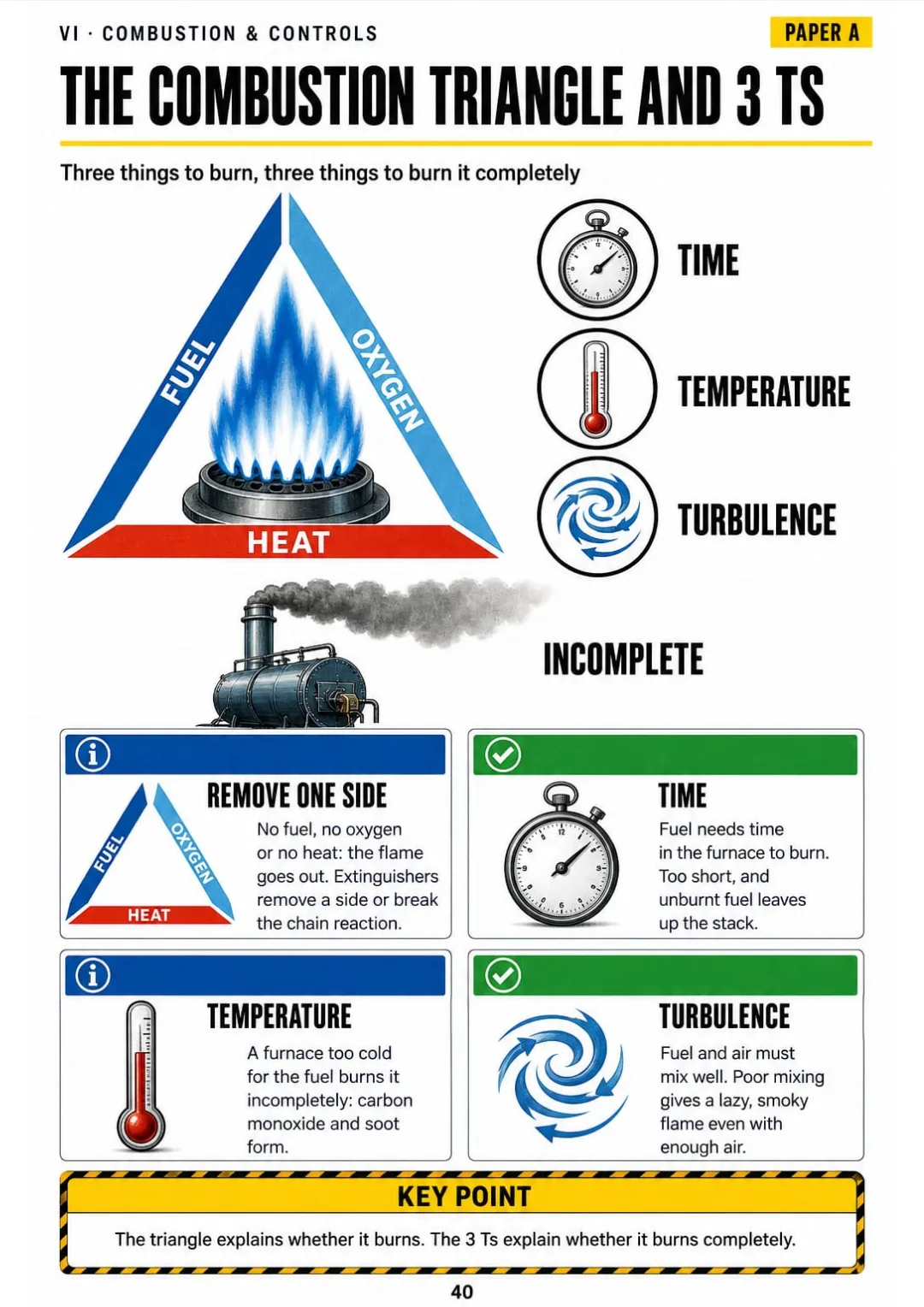
Fuel, oxygen, heat · time, temperature, turbulence, and the smoky stack when one is missing
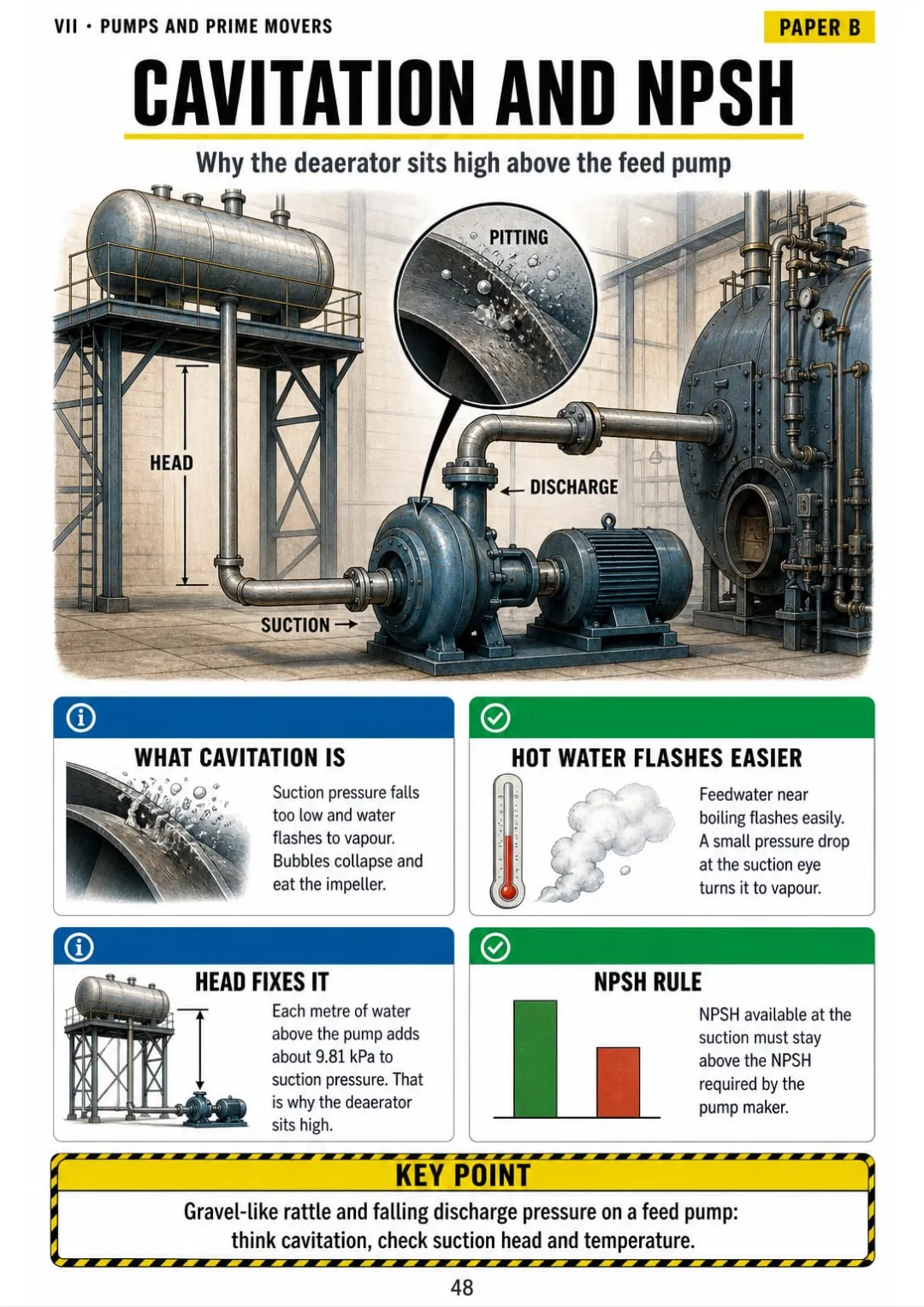
Cavitation: low suction pressure flashes water to vapour; height on the suction prevents it.
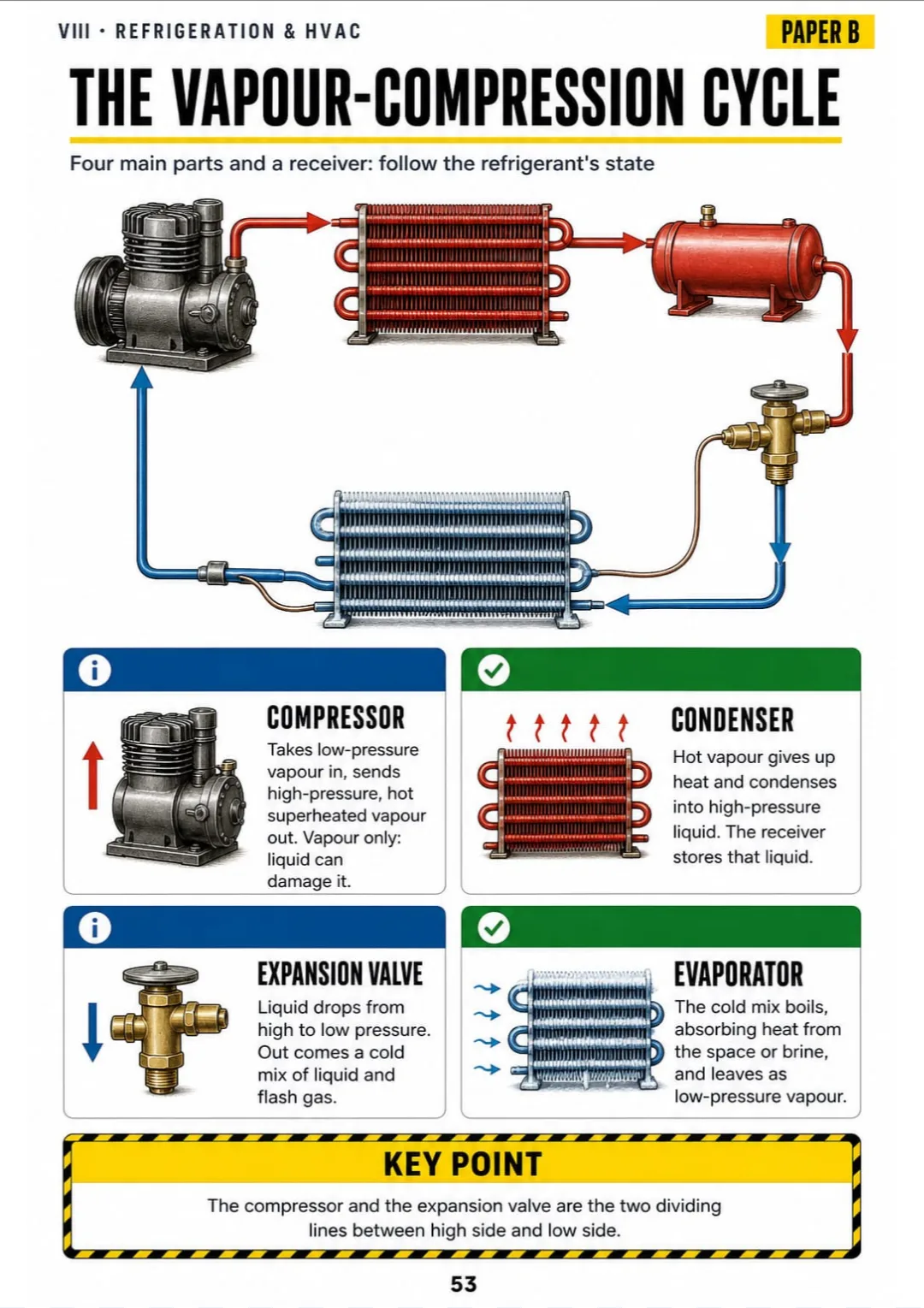
Compressor → condenser → receiver → expansion valve → evaporator, high side red, low side blue

Swipe to see more →

These are real pages from the book. The table of contents is the full one: 9 parts and 60 topics.

The Problem Isn't You. It's How It Was Explained.

You're doing a practice Paper A after your shift and the question reads: who enforces the rules on the boiler you run? The province, CSA or ASME? You've seen all three names, and they blur together.

The textbook covers it in pages of paragraphs: acts, regulations, codes, standards, adoption by reference. Nothing shows you who does what.

Province enforces, CSA B51:24 covers boilers, CSA B52:23 covers refrigeration, ASME covers design.

In the book it's one page: the province on top as the one that enforces, CSA B51 for boilers, CSA B52 for refrigeration, ASME for design, each in its own box with an arrow to what it covers.

The rest works the same way: the safety valve in cutaway, the low-water cutoff, the gas train, the centrifugal pump and the refrigeration cycle. Each one has its own page.

When the question comes up, on the exam or from the chief engineer, you picture the page and answer without going back to the textbook.

COMPARE FOR YOURSELF

The Same Topic, Two Ways to Study It

THIS
  • The textbook: lines and lines of text
  • Pressure, force and area explained only in words
  • You walk into Paper A with doubts
Pressure is defined as the force exerted per unit area and is expressed in the SI system in pascals, one pascal being equal to one newton per square metre; in power plant practice the kilopascal is the customary unit. To determine the total force acting upon a surface such as a manhole cover or a boiler head, the pressure is multiplied by the area, which must first be expressed in square metres, it being noted that dimensions given in millimetres require conversion before the area is computed.
FOR THIS
  • Pressure = force ÷ area in one drawing
  • The units and conversions in a box
  • 500 kPa on a 300 × 400 mm cover: 47.1 kN, worked on the drawing
500 kPa on a 300 × 400 mm manhole cover = 47.1 kN, area in m² first
CONTENTS

Take a Look at the 9 Parts and 60 Topics

The plant at a glance, Paper A calculations, codes and piping, boilers, fittings and water, combustion and controls, pumps and electricity, refrigeration and HVAC, and an exam review: 64 pages, all illustrated.

IThe Plant at a Glance · pp. 5-10
  1. The Steam Plant as a Map
  2. Gauge vs Absolute Pressure
  3. Temperature, Heat and the Boiling Point
  4. Sensible Heat vs Latent Heat
  5. Plant Safety: Lockout and Isolation
  6. Confined Space, Ammonia and Hot Work
IICalculations for Paper A · pp. 11-18
  1. Pressure = Force ÷ Area
  2. Head of Water in kPa
  3. Q = m × c × ΔT
  4. Reading the Steam Tables
  5. Dryness Fraction and Wet Steam
  6. Work, Power and Efficiency
  7. Levers, Pulleys and Mechanical Advantage
  8. Boiler Efficiency and Evaporation
IIICodes, Materials, Piping and Drawings · pp. 19-24
  1. Who Regulates Your Boiler
  2. Boiler Plant Classes and Supervision
  3. Boiler Materials and Stresses
  4. Welding and Joints in Pressure Parts
  5. Valves: Gate, Globe, Check, Ball
  6. Piping Symbols and Reading a Drawing
IVBoilers · pp. 25-31
  1. Firetube vs Watertube
  2. The Scotch Marine Boiler in Cutaway
  3. The Watertube Boiler: Drums and Circulation
  4. Cast Iron Sectional and Electric Boilers
  5. Heating Surface and Boiler Rating
  6. Superheaters, Economizers and Air Heaters
  7. Boiler Inspections and the Hydrostatic Test
VBoiler Fittings and Water · pp. 32-39
  1. The Safety Valve
  2. Pressure Gauge and Siphon
  3. Gauge Glass and Try Cocks
  4. Low-Water Cutoff: Float and Probe
  5. Feedwater Line: Stop Valve and Check Valve
  6. Bottom Blowdown vs Continuous Blowdown
  7. Scale, Corrosion and Carryover
  8. Water Treatment: Softener, Deaerator, Chemicals
VICombustion and Controls · pp. 40-46
  1. The Combustion Triangle and the 3 Ts
  2. Excess Air and Flue Gas Reading
  3. Natural Gas Train
  4. Burner Management as a Chain
  5. Purge and Trial for Ignition
  6. Flame Scanners and Flame Failure
  7. Operating Control vs High Limit
VIIPumps, Prime Movers and Electricity · pp. 47-52
  1. Centrifugal Pump in Cutaway
  2. Cavitation and NPSH
  3. Steam Traps
  4. Steam Turbines: Impulse and Reaction
  5. Air Compressors and Lubrication
  6. Electricity for the Power Engineer
VIIIRefrigeration and HVAC · pp. 53-59
  1. The Vapour-Compression Cycle
  2. Pressure-Temperature: Why Gauges Tell Temperature
  3. Superheat and Subcooling
  4. Ammonia in the Arena
  5. Refrigerants and Safety Groups
  6. Absorption vs Compression
  7. HVAC Basics for Buildings
IXExam Review · pp. 60-64
  1. Units That Cost Marks
  2. Fittings Checklist from Memory
  3. Start-Up, Operation and Shutdown
  4. Emergency: Low Water and Flame Failure
  5. How Multiple-Choice Questions Are Written

One Page, One Topic, All Clear

Think of it this way:

You're on shift, the low-water cutoff trips and the chief engineer asks what happens next. You need the order, not a paragraph.

In the book you open the burner management page and see it drawn as a chain: low-water cutoff, flame safeguard, pressure control, each link showing what it shuts down.

Bourdon tube drawn open and the pigtail siphon's water seal

Same with the safety valve, the gauge glass and try cocks, the steam tables, the centrifugal pump and the vapour-compression cycle: each one on its own page.

4th Class Power Engineer Illustrated is 9 parts and 60 topics, all drawn, with an exam review at the end: units, a fittings checklist, start-up and shutdown, emergencies and how multiple-choice questions are written.

What you see drawn, you don't have to memorize.

What's Inside 4th Class Power Engineer Illustrated:

Ipp. 5-10

The Plant at a Glance

The steam plant as a map, gauge vs absolute pressure, heat and boiling point, sensible and latent heat, lockout, confined space, ammonia and hot work.

IIpp. 11-18

Calculations for Paper A

Pressure = force ÷ area, head of water in kPa, Q = m × c × ΔT, steam tables, dryness fraction and efficiency, each one a worked example in kPa and °C, so the Paper A math stops being a guess.

IIIpp. 19-24

Codes, Materials, Piping and Drawings

Who regulates your boiler, plant classes and supervision, materials and stresses, welded joints, gate, globe, check and ball valves, and reading a piping drawing.

IVpp. 25-31

Boilers

Firetube vs watertube, the Scotch marine boiler in cutaway, drums and circulation, cast iron and electric boilers, heating surface, superheaters and the hydrostatic test.

Vpp. 32-39

Boiler Fittings and Water

Safety valve, pressure gauge and siphon, gauge glass and try cocks, low-water cutoff, feedwater, blowdown and water treatment: the fittings the chief engineer asks about, each one shown in its place on the boiler.

VIpp. 40-46

Combustion and Controls

The combustion triangle and the 3 Ts, excess air and flue gas, the natural gas train, burner management as a chain, purge, flame scanners and high limit.

VIIpp. 47-52

Pumps, Prime Movers and Electricity

Centrifugal pump in cutaway, cavitation and NPSH, steam traps, impulse and reaction turbines, air compressors and electricity for the power engineer.

VIIIpp. 53-59

Refrigeration and HVAC

The vapour-compression cycle, pressure-temperature, superheat and subcooling, ammonia in the arena, refrigerant safety groups, absorption and HVAC basics.

IXpp. 60-64

Exam Review

Units that cost marks, a fittings checklist from memory, start-up and shutdown, low water and flame failure, and how multiple-choice questions are written.

At the end of the book: Worked examples in kPa and °C and an exam review part with a fittings checklist and start-up and shutdown steps.
Plus: 2 Free Books

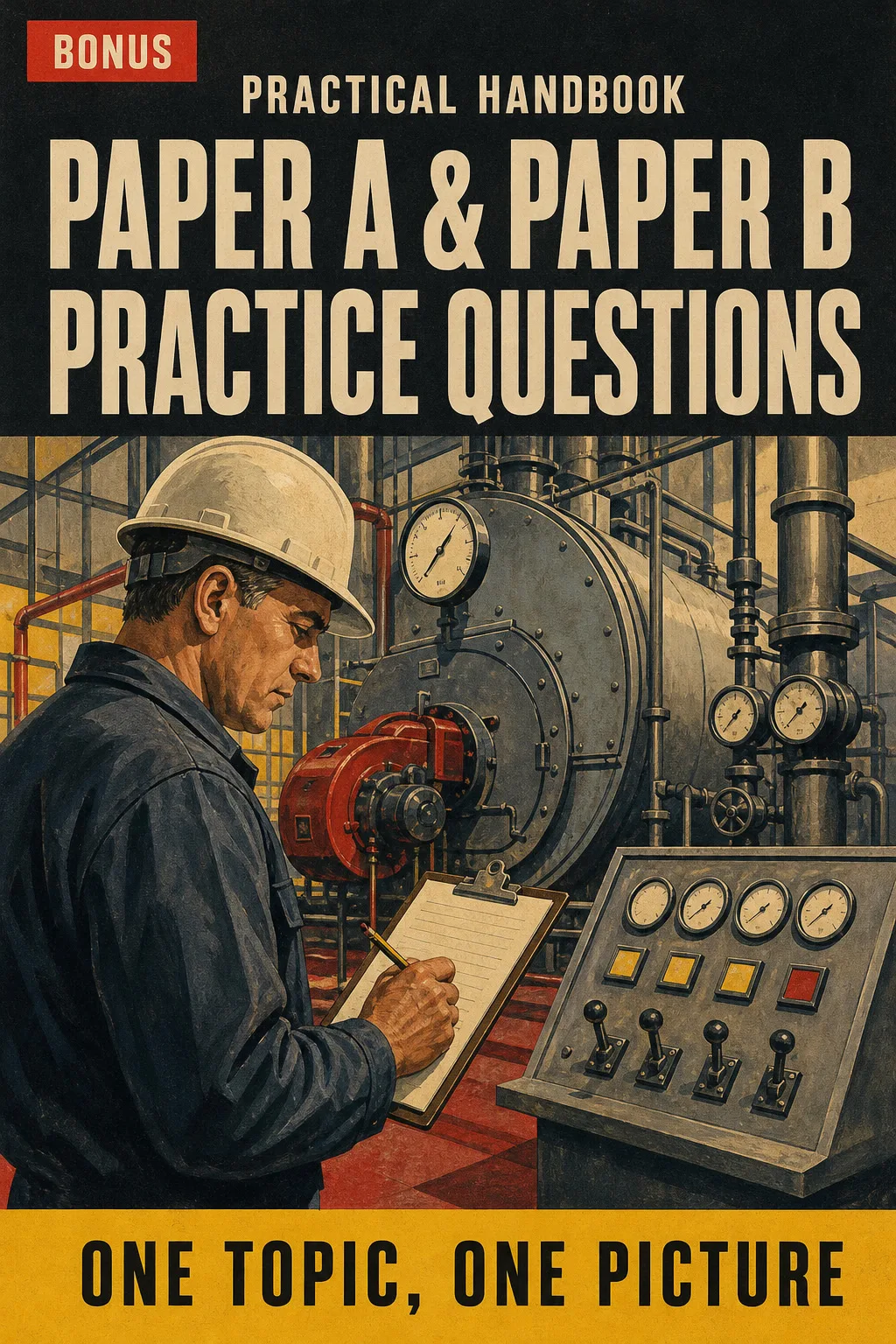
Paper A & Paper B Practice Questions

BONUS 1: «Paper A & Paper B Practice Questions»

Value on its own: US$ 17.90

Practise with exam-style multiple-choice questions for each paper and check every answer against the page that explains it.

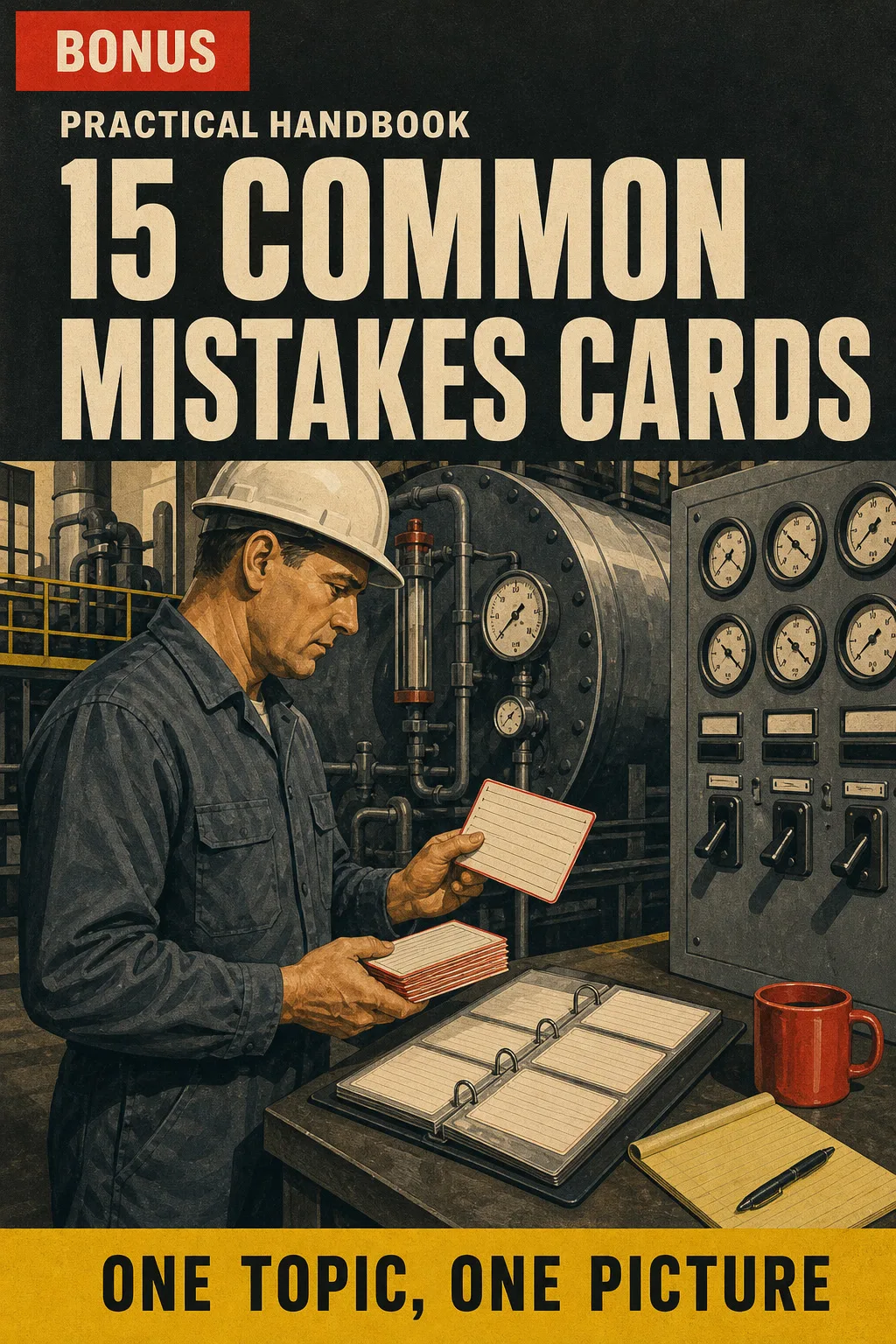
15 Common Mistakes Cards

BONUS 2: «15 Common Mistakes Cards»

Value on its own: US$ 14.90

Review the mistakes operators make most often (gauge glass, blowdown, safety valves, units), each one drawn before and after, ready to print and keep on hand.

4th Class Power Engineer Illustrated with 2 Free Books

  • 4th Class Power Engineer Illustrated: 64 illustrated pagesUS$ 63
  • BONUS 1: Paper A & Paper B Practice QuestionsUS$ 17.90
  • BONUS 2: 15 Common Mistakes CardsUS$ 14.90
  • High-resolution PDF to printIncluded
Total value US$ 95.80
YOUR PRICE:
US$ 27
You save US$ 68.80
YES, I WANT 4TH CLASS POWER ENGINEER ILLUSTRATED FOR US$ 27

📄 This is a digital PDF book sent to your email: nothing is printed or shipped.

Secure purchaseEncrypted payment30-day guarantee

PDF by email: We email you 4th Class Power Engineer Illustrated as a PDF, together with the two free books. It's a single payment: no installments, no extra charges.

Who This Book Is For

You're working through the course

You're working through the course

Each textbook chapter becomes one drawing you can come back to, so the forty fittings finally have a place on the boiler.

Paper A or Paper B is coming up

Paper A or Paper B is coming up

You review the whole plant in the same order, from the steam loop to the refrigeration cycle, with worked examples in kPa and °C.

You already run the plant

You already run the plant

You see why the gauge glass, the low-water cutoff and the safety valve work the way they do, and you have the answer when the chief engineer asks.

Everything You Get Today

US$ 95.80US$ 27
YES, I WANT 4TH CLASS POWER ENGINEER ILLUSTRATED FOR US$ 27

📄 This is a digital PDF book sent to your email: nothing is printed or shipped.

30DAYS
GUARANTEE

30-Day Guarantee

Try 4th Class Power Engineer Illustrated for 30 days, bonus books included.

We refund everything if the file won't open, if the book isn't what you see here, if you were charged twice or if the email doesn't arrive. Just email us.

You pay once. No subscriptions.

Frequently Asked Questions

Is it for me if I already work near a boiler or an ice plant and haven't written an exam in years?

Yes. It's built for people who already see the plant every day. It doesn't replace your course textbooks: it turns each chapter into one drawn page, puts the forty fittings in their place on the boiler and shows the Paper A calculations as worked examples in kPa, so you review in the same order instead of rereading hundreds of pages.

Where does the content come from?

From the national 4th Class Power Engineer syllabus used by the provincial regulators for Papers A and B (4A and 4B), with CSA B51 and CSA B52 cited for reference. It's written for Alberta, Ontario, BC, Saskatchewan and the other provinces and territories, and every code limit is marked to verify with your province: ABSA, TSSA, Technical Safety BC, TSASK or your local authority.

Is this official material?

No. It's an independent illustrated study book, not affiliated with or endorsed by any regulator, exam body or standards organization.

Does it replace my course or training?

No. It helps you study and review alongside your course, your supervised plant time and your plant's procedures. It doesn't give you a certificate or count toward your qualifying time: those come only from your course and your provincial authority.

Are the practice questions the ones on the exam?

No. They're exam-style questions written for this book, each one linked to the page that explains it.

When and how do I get it?

The book and the 2 bonus books arrive as PDFs by email, at the address you enter at checkout.

Do I have to pay every month?

No. It's a one-time payment. If your employer is covering it, write to us and we'll send you the receipt by email.

Can I have it on paper?

Yes. The PDFs are ready to print, so you can keep the pages you need in the boiler room.

How does the refund work?

You have 30 days. We refund everything if the file won't open, if the book isn't what you see on this page, if you were charged twice or if the email doesn't arrive: just email us.

Before You Close This Page

No more rereading the textbook with nothing sticking.

The safety valve, the gas train and the refrigeration cycle: you see them drawn, and that's it.

You walk into Paper A knowing where everything is.

Drawings make studying faster.

The book is right below.

One-time payment: US$ 27 · Guarantee: 30 days · PDF by email

YES, I WANT 4TH CLASS POWER ENGINEER ILLUSTRATED FOR US$ 27

📄 This is a digital PDF book sent to your email: nothing is printed or shipped.